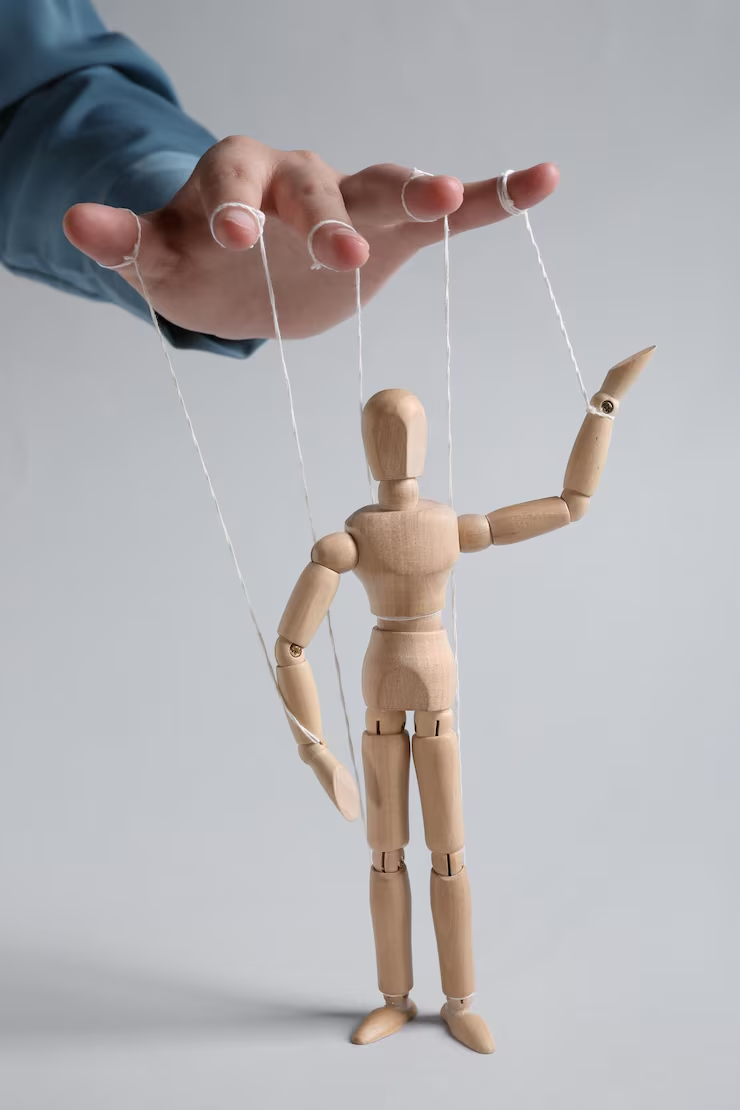
There is a polite fiction in modern business that the organisations which move slowly are being careful.
They are not being careful. They are being frightened.
Frightened of making the wrong call. Frightened of backing the wrong person. Frightened of committing to a direction that might later need to change. Frightened, above all, of accountability.
So we invent process to make that fear look respectable.
We call more meetings. We ask for more alignment. We create steering groups, stage gates, approval forums, design councils, architecture boards, prioritisation rituals, operating committees, and enough pre-read paperwork to deforest a small country. Then we act surprised when nothing meaningful gets shipped, fixed, sold, or learned.
That is not strategy. That is institutionalised hesitation.
I have spent enough time in military environments and product organisations to notice that the biggest difference between the two is not discipline, hierarchy, or even competence. It is the relationship with uncertainty.
In the military, uncertainty is assumed. Nobody is waiting for perfect information because perfect information does not exist. You get the mission, the constraints, the intent, and then you move. The expectation is not that you will get everything right. The expectation is that you will think, act, adapt, and keep going.
In business, especially in large or upwardly mobile organisations, uncertainty is often treated like an administrative failure. People behave as though ambiguity itself is unacceptable. So instead of acting under imperfect conditions, they try to design ambiguity out of the system.
They never succeed. They just slow the system down.
This is one of the great unspoken problems inside companies that talk endlessly about transformation. They think their issue is structure. Or talent. Or legacy technology. Or culture. Usually those things matter, but they are not the root of it.
The real issue is that the organisation has lost its nerve.
It no longer trusts competent people to make bounded decisions. It no longer distinguishes clearly between reversible and irreversible choices. It no longer rewards intelligent movement; only socially safe movement. The people inside it learn this quickly. They stop trying to win and start trying not to be blamed.
That is when decline begins, even if revenue still looks healthy.
Revenue is a lagging indicator. So is morale, if we are honest. Long before the numbers turn, the operating model starts telling on itself. Decision cycles lengthen. Ownership becomes performative. Meetings become theatre. Plans become longer and weaker at the same time. Everyone says the right things. Nobody is really in command of the work.
And because modern business loves the language of empowerment while distrusting empowered behaviour, many companies end up with the worst of both worlds: centralised fear and decentralised confusion.
That is why I increasingly think that many operating model problems are moral problems before they are structural ones.
Not moral in the preachy sense. Moral in the older sense: courage, seriousness, responsibility, restraint.
Can your leaders make a call without hiding behind a committee? Can they state intent clearly enough for others to act? Can they tolerate a good decision made at 70 percent certainty? Can they tell the difference between governance that protects value and governance that protects careers?
These are not soft questions. They are operational questions.
And they matter because most companies are now living in conditions where speed of learning beats elegance of planning. Markets shift. Customer expectations move. Technology compresses timelines. Distribution advantages disappear faster than they used to. In that environment, the company that requires universal social agreement before action is not being prudent. It is simply handing initiative to someone else.
This is where the lesson gets uncomfortable.
A lot of senior people secretly prefer the illusion of control to the reality of performance.
The illusion of control is neat. It comes with dashboards, statuses, sign-offs, and the comforting feeling that nothing embarrassing will happen without passing through the proper channels.
The reality of performance is messier. It requires trust. It requires sharper priorities. It requires giving good people room to operate. It requires accepting that some errors are the price of movement. It requires leaders to be visible when things go wrong instead of disappearing into process.
That is harder. It is also the only thing that works.
I did not always understand this properly. Like a lot of people who are used to moving quickly, I once thought the answer was simply to push harder, cut through the noise, and get on with it. Sometimes that works. Sometimes it just creates a different kind of friction, because organisations are social systems, not just production engines. If you ignore the politics entirely, you can move fast in the wrong direction and discover too late that nobody is actually following.
So this is not an argument for recklessness. It is an argument for adult leadership.
Adult leadership says: here is the mission, here are the boundaries, here is who owns what, here is how we will decide, here is what matters now, and here is what we will learn if this fails.
That kind of clarity is rare. Which is why it is valuable.
The companies that win in the next decade will not necessarily be the ones with the most sophisticated strategy decks. They will be the ones that rebuild decision confidence into the operating model. They will know where control is essential and where freedom is productive. They will make fewer decisions by committee. They will treat speed as a capability, not a personality trait. And they will stop confusing internal consensus with external competitiveness.
Most businesses do not need another transformation programme.
They need their nerve back.